We are a national leader in raising awareness of deaf health disparities, promoting strategies to improve deaf health, and increasing deaf communities’ access to affordable and quality healthcare. We provide bilingual navigation and enrollment support, accessible health education, patient advocacy, community engagement, and health system partnerships to make access the standard rather than the exception.
This work is rooted in five decades of history. We are the health and patient advocacy division of Communication Service for the Deaf (CSD) – the world’s largest deaf-led nonprofit with more than 50 years of building the tools, trust, and infrastructure to advance communication access, employment, education, and health outcomes for deaf communities. From building the first video relay services to operating national crisis lifelines, CSD has spent five decades proving that when you design for deaf people first, everyone benefits. DeafHealth is where that work meets healthcare -because deaf health access shouldn’t depend on whether the system was designed for you.
Stay connected with us. Sign up with your email at deafhealthaccess.org/sign-up or follow us on social media for health updates.
Video Description & Transcript
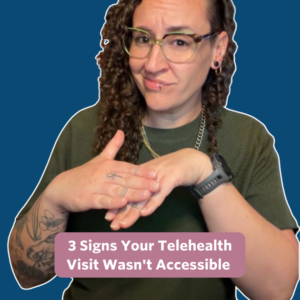
[VD: The post has a video thumbnail with blue shading overlaid. The middle has a text bubble that reads “3 Signs Your Telehealth Visit Wasn’t Accessible” in white text with rose background. In the video: A white woman with long blonde wavy hair, wearing a navy top with “CSD” signage in the background. Allysa is signing to the camera.
Transcript:
Current research shows that the deaf community experiences worse health outcomes compared to those who can hear. The reason is that the system is not accessible, period.
We’re more likely to have cancer, diabetes, heart conditions, mental health challenges, and emergency room visits. There are so many layers in the healthcare system.
Everywhere we go, whether it’s a hospital or a doctor’s office, it’s audio-based. Whether it’s in the waiting room when they call your name and you miss it, or in the operating room where multiple conversations are taking place – it’s hard to understand and communicate as a deaf person.
We struggle with health literacy so much more than the general population. It doesn’t matter what education level you have, whether it’s a PhD degree or a high school degree – we will still struggle to navigate the healthcare system. It goes back to the system. The system was not built for us.
Most recently, when the COVID-19 pandemic hit, existing barriers became worse. We were really left behind. We try hard to address these health barriers through different programs, services, and innovation. We’re one of very few organizations that are dedicated to deaf health services and resources. In fact, I can probably count on just one hand how many organizations there are in the entire country.
At DeafHealth, we focus on four core areas.
The first is patient health education. So much of the health information out there is not accessible. We help break down the information and translate it into content that is easy to understand. We also provide training to help people apply health information and knowledge into real action.
We also do patient advocacy. That is the heart of what we do every day – from one-on-one support through our first-of-its-kind hotline, where deaf patients can call deaf bilingual representatives directly in their language, to policy advocacy at the local, state, and federal levels.
We also do research support. There isn’t enough data about our community. There’s so much research out there, but it often overlooks our community. We are left behind. We help bridge that gap.
And we show organizations what real accessibility looks like. We are deaf-led and deaf-operated. We know what works, and what doesn’t work. When we don’t know, we immerse ourselves in the community and figure out solutions. That approach is very authentic, intentional, and rooted in justice.]